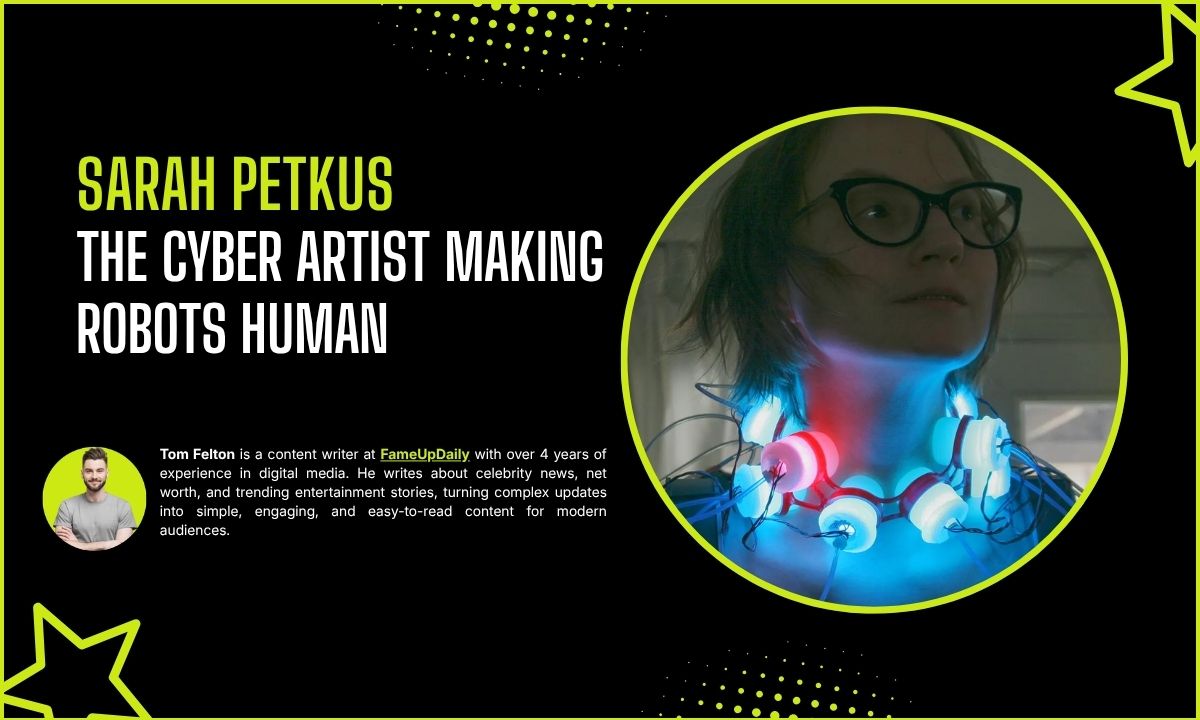
Sarah Petkus is a well-known cyber artist who gives machines real feelings. She builds robots that act nervous, curious, and emotionally alive. Her creative work challenges everything people assume about technology.
Most artists use paint or clay as their creative tool. Sarah Petkus uses circuit boards, code, and 3D printers instead. She turns digital engineering into a deeply personal form of expression.
Her work sits at a rare crossroads between science and emotion. She does not build machines to complete tasks or serve people. She builds them to connect with people on a human level.
Who is Sarah Petkus? The Artist Blending Robotics and Art
Sarah Petkus is a roboticist and illustrator living in Las Vegas, Nevada. She designs machines that carry emotional personalities rather than industrial functions. Her robots feel fear, show curiosity, and even seek physical comfort.
Rather than following standard engineering goals, she flips the whole concept around. Sarah Petkus programs behavioral imperfections directly into the core of each machine. This makes her creations feel fragile, relatable, and surprisingly alive.
Her philosophy challenges the cold and efficient image of modern robotics. She believes technology should build emotional bridges between humans and machines. Her ongoing work continues to push that idea further every year.
See More: Barbara Smits
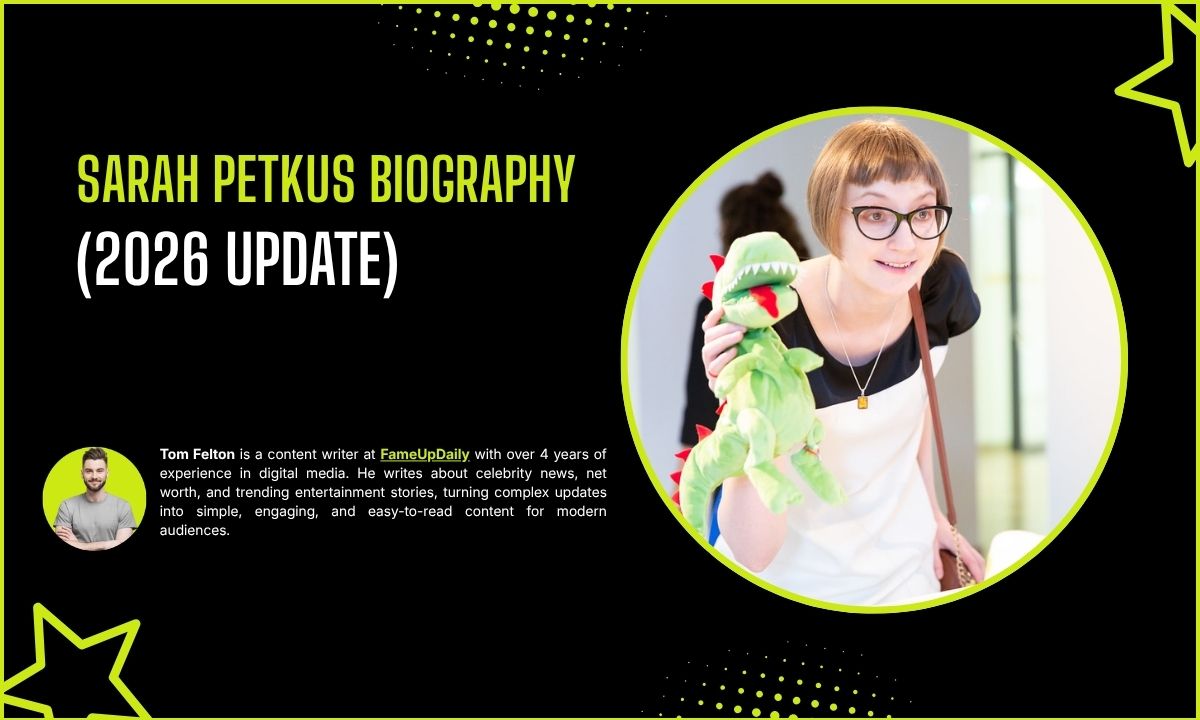
Sarah Petkus Biography
| Detail | Information |
| Full Name | Sarah Petkus |
| Profession | Cyber Artist, Roboticist, Illustrator |
| Based In | Las Vegas, Nevada, USA |
| Nationality | American |
| Education | College of Southern Nevada (CSN); Rocky Mountain College of Art and Design |
| Partner | Mark J. Koch (Electronics Engineer) |
| Famous Project | NoodleFeet (Quadrupedal Robot) |
| Other Projects | SHE BON, Moon Rabbit, The Wandering Artist |
| TV Appearance | MythBusters: The Search (Science Channel, 2017) |
| ESA Residency | Planetary Robotics Lab, Noordwijk, Netherlands (2017) |
| Webcomic | Gravity Road |
| Social Media | Instagram: @spetku / Mastodon: @spetku |
| Blog | roboticarts.wordpress.com |
| Philosophy | Open-source hardware and non-utilitarian robotics |
Sarah Petkus Age
Sarah Petkus keeps her personal birth details completely away from public view. She focuses her public presence entirely on her creative and technical work. No verified birth year or age has been confirmed through any official source.
Based on her career timeline, she completed her studies in the mid-2000s to early 2010s. She became widely known in maker communities between 2014 and 2015. Her major international breakthrough came in 2017 with both her ESA residency and TV appearance.
Sarah Petkus Age Details (Based on Career Timeline)
| Detail | Information |
| Birth Date | Not publicly disclosed |
| Birth Year | Estimated early-to-mid 1980s (unconfirmed) |
| Education Period | Mid-2000s to early 2010s |
| Maker Community Active | 2014–2015 |
| Global Recognition Year | 2017 |
| Current Status | Actively working in Las Vegas, Nevada (2026) |
Sarah Petkus Family
Sarah Petkus does not share details about her biological relatives online. She keeps that part of her personal life private and separate from her public work. What she does share openly is her creative family, which she has described in interviews.
Her longtime partner, Mark J. Koch, is both a life companion and co-creator. He is a skilled electronics engineer who builds the technical foundations of their shared projects. Together, they have developed major interactive installations, including SHE BON and Moon Rabbit.
Sarah Petkus calls herself the “mother of robots” and means it with full sincerity. Her flagship robot, NoodleFeet, behaves like a temperamental toddler who needs constant attention. She treats the ongoing process of raising and reprogramming him as a form of modern parenthood.
Sarah Petkus Career
Sarah Petkus built her career by refusing to separate art from engineering. She started as a graphic storyteller and slowly transformed into a full-scale robotics creator. Each step in her journey pushed the boundaries of what machines are allowed to be.
Her 2017 breakthroughs placed her on both the television stage and inside a real space research center. She competed on a major science television program while also earning a prestigious international artist residency. That single year turned her from a respected indie creator into a globally recognized figure.
Career Timeline and Key Milestones
- Early 2010s — Created the webcomic Gravity Road; began teaching herself coding and 3D printing to bring illustrated characters to physical life.
- 2014–2015 — Joined the global maker movement; became a regular contributor and presenter at Hackaday and the Hackaday Superconference.
- 2017 — Competed as a contestant on the Science Channel’s reality show MythBusters: The Search over seven episodes.
- 2017 — Received an honorary mention at Ars Electronica Festival and earned a research residency at the ESA Planetary Robotics Lab in the Netherlands.
- 2018–Present — Continued developing NoodleFeet, SHE BON, and launched the Moon Rabbit AI astronomy project with Mark J. Koch.
- 2021 — Moon Rabbit was recognized and featured through Ars Electronica’s international platform.
- 2026 — Still actively creating and sharing open-source robotics projects from her Las Vegas studio.
Sarah Petkus on Social Media
Sarah Petkus uses her online platforms as a live, transparent engineering notebook. She shares raw footage of her builds, programming errors, and design experiments openly. Her goal is to invite global feedback rather than present polished finished products.
She actively participates in the open-source hardware and maker communities online. Sarah Petkus treats every post as an invitation for collaboration and conversation. Her digital presence is as much a part of her art practice as the machines themselves.
Sarah Petkus Social Media Platforms
| Platform | Handle / Link | Purpose |
| @spetku | Build photos, robot tests, behind-the-scenes content | |
| X / Twitter | @SarahPetkus | Real-time updates for the maker and tech community |
| Mastodon | @spetku@mastodon.social | Community interaction with developers and artists |
| Robotic Arts Blog | roboticarts.wordpress.com | Deep-dive technical logs, PCB schematics, open-source code |
| YouTube | Hackaday Channel features | Video documentation of builds and conference talks |
See More: Stuart Frankel
Sarah Petkus Net Worth
Sarah Petkus has never publicly shared her financial details or personal wealth. She works as an independent artist and operates completely outside the corporate technology world. Standard net worth figures used for celebrities simply do not apply to her work model.
Her income comes from creative grants, media exposure, and community support rather than product sales. Sarah Petkus intentionally avoids commercializing her robots as consumer goods. Her financial priority has always been keeping her work freely accessible to the public.
Sarah Petkus Net Worth Overview
| Category | Detail |
| Estimated Net Worth | Not publicly disclosed |
| Income Type | Grants, residencies, writing, speaking, crowdfunding |
| Corporate Affiliations | None |
| Commercial Product Sales | None (open-source philosophy) |
| Major Funded Projects | ESA residency, Ars Electronica installations |
| Financial Approach | Independent studio model with community patronage |
Sarah Petkus Source Of Income
Sarah Petkus earns her living through a combination of artistic and technical channels. She does not rely on any single company, sponsor, or product line for financial stability. Her income model reflects her core belief in open, accessible, and non-commercial creative work.
Institutional grants from organizations like Ars Electronica and the ESA have funded her largest projects. Sarah Petkus also earns fees from technical writing, public speaking, and media appearances. Her community of supporters provides ongoing financial backing through direct patronage platforms.
Income Sources Breakdown
| Income Source | Description |
| Institutional Grants | Funding from Ars Electronica, ESA, and similar science-art organizations |
| Technical Writing | Paid contributions to Hackaday and maker-focused publications |
| Speaking Engagements | Honorariums from tech conferences, academic events, and design festivals |
| TV Appearance | Commercial compensation from MythBusters: The Search (2017) |
| Community Crowdfunding | Direct patronage from global makers and open-source supporters |
| Residency Stipends | Research budgets and living support from international residencies |
Inside NoodleFeet: Sarah Petkus Famous 3D-Printed Robot
NoodleFeet is the most celebrated creation in the entire body of work by Sarah Petkus. He is a four-legged physical robot pulled directly from her illustrated webcomic, Gravity Road. Rather than performing useful tasks, he was built entirely to feel and express emotion.
The robot’s pale skeletal body was fabricated using desktop FDM 3D printing technology. Custom star-shaped circuit boards distribute power and signals across all four limbs. Low-cost servo motors connect to 3D-printed joints to create deliberately clumsy, organic movement.
One of his most remarkable features is how he experiences his surroundings. Specialized sensors on his feet allow him to chemically interact with liquids on the ground. He also carries internal fluid reservoirs so he can produce a biological-looking response when he encounters something interesting.
Sarah Petkus SHE BON: Exploring Wearable Tech and Electronic Expression
SHE BON is a wearable technology project co-created by Sarah Petkus and her partner Mark J. Koch. It is a modular suit of body-worn devices designed to sense and display human physiological responses. The project uses open-source hardware to start honest public conversations about intimacy and the human body.
Each module in the SHE BON system targets a different part of the body with custom-built sensors. A heart-shaped backpack acts as the central control hub connecting all components. One module uses infrared sensors to detect subtle physical changes and triggers mechanical propellers in response.
The project forced Sarah Petkus to move beyond rigid robotics into soft and organic design. Working with the human body required flexible materials, silicone casting, and moisture-resistant circuitry. SHE BON was recognized as a notable finalist in the Human-Computer Interface category of the Hackaday Prize.
Sarah Petkus From Gravity Road to the European Space Agency: Her Artistic Journey
Sarah Petkus began her creative life drawing illustrated characters in a self-published webcomic. Gravity Road explored themes of loneliness, mechanical curiosity, and the inner lives of non-human beings. Over time, she grew frustrated that these characters could only exist as flat images on a page.
She decided to teach herself the tools needed to bring those characters into physical reality. She studied Python, C++, 3D modeling software, and custom circuit board design entirely on her own. The result was NoodleFeet, a living, breathing robot version of her illustrated world.
By 2017, her approach to robotics had caught the attention of the European Space Agency. Sarah Petkus earned a residency at their Planetary Robotics Lab in the Netherlands through Ars Electronica. There, she proposed a radical idea: a space exploration probe that wanders based on artistic curiosity instead of scientific data grids.
How Sarah Petkus Redefines Human-Robot Interaction
Sarah Petkus approaches human-robot interaction from a completely different angle than most engineers. She does not want people to feel impressed or intimidated by her machines. She wants people to feel genuine warmth, empathy, and emotional recognition toward them.
She achieves this by programming deliberate flaws and emotional responses into every machine. Her robots hesitate, panic, seek comfort, and react to touch in unpredictable ways. These qualities make them feel like living creatures rather than engineered devices.
This approach has influenced how artists, engineers, and researchers think about emotional design. Sarah Petkus has shown that a machine does not need to be smart to be meaningful. It only needs to feel honest, vulnerable, and alive in the moment of interaction.
The Future of Bio-Mechanical Art: What’s Next for Sarah Petkus?
Sarah Petkus is actively moving her work toward deeper integration between human biology and machine behavior. Her future projects focus on wearable devices that read and physically respond to subconscious body signals. She is exploring soft robotics, microfluidics, and flexible printed circuits for this next phase.
NoodleFeet continues to evolve as an ongoing experiment rather than a finished sculpture. She regularly rewrites his behavioral code to make his emotional responses more nuanced and complex. Instead of making him smarter, she is making him more emotionally layered and reactive.
Her Moon Rabbit project is expanding into new territory with artificial intelligence and deep space imagery. She is training machine vision systems to experience pareidolia, seeing familiar shapes in star clusters and cosmic data. This work challenges the idea that space exploration must always be objective and emotionally neutral.
Interesting Facts About Sarah Petkus
Sarah Petkus is as unconventional as the machines she creates. Her personal quirks and creative decisions reveal a mind that operates completely outside the mainstream. Several of the most unexpected details about her come directly from her own public writings and presentations.
She describes herself in her maker profile as a “raptor piloting an androgynous human body” with a strong personal attachment to cheese. Sarah Petkus once noted that NoodleFeet got its name from the cheap pool noodles wrapped around its legs during early prototyping. These small details paint a vivid picture of a creator who never takes herself too seriously.
Surprising Facts Worth Knowing
- NoodleFeet was literally named after dollar-store foam pool noodles used in its very first prototype stage.
- One of NoodleFeet’s behavioral programs teaches him to plant a single bean underground, because he loves beans and may one day need to grow food on Mars.
- A visit to NASA’s Jet Propulsion Laboratory inspired her to completely redesign NoodleFeet’s feet after she saw the LEMUR probe’s hundreds of tiny gripping toes.
- SHE BON’s name is a phonetic play on the French phrase “si bon,” meaning “so good,” chosen intentionally for its playful and sensual tone.
- During her ESA residency, she made top aerospace scientists stop and ask why space rovers cannot be emotionally driven explorers instead of data-collecting machines.
- She openly shares all her code, circuit diagrams, and blueprints online so any artist anywhere can build and experiment freely.
See More: Marian Mapother
Sarah Petkus Now Today
As of 2026, Sarah Petkus continues to work from her personal studio in Las Vegas, Nevada. She and Mark J. Koch are actively developing the Moon Rabbit project with expanded AI capabilities. The project trains machine vision to find human-like patterns and folklore imagery inside real astronomical datasets.
SHE BON is entering a new phase of development with updated materials and refined sensor technology. Sarah Petkus is now incorporating fire-retardant composites and flexible micro-circuitry into the new version. The goal is to map real-time biological states like breath, heat, and muscle tension to physical mechanical movement.
NoodleFeet remains an active, evolving presence in her studio rather than a finished display piece. She continues rewriting his behavioral code to make his emotional reactions more layered and unpredictable. Her open-source community receives regular updates, new schematics, and live documentation through her blog and social channels.
Last Words
Sarah Petkus has proven that engineering and fine art are not separate disciplines. She builds machines that feel human, behave unpredictably, and challenge every assumption we carry about technology. Her work will continue to matter as long as people wrestle with what it means to live alongside intelligent machines.
Her open-source philosophy ensures that her influence reaches far beyond any single gallery or research lab. Anyone with curiosity, a 3D printer, and the willingness to learn can build upon her published work. That accessibility is perhaps her greatest and most lasting contribution to the world of creative technology.
Frequently Asked Questions
Who is Sarah Petkus?
Sarah Petkus is an American cyber artist, illustrator, and roboticist based in Las Vegas who builds emotionally expressive robots and wearable technology designed to explore the human relationship with machines.
What is Sarah Petkus Noodle?
Sarah Petkus Noodle, officially called NoodleFeet, is a four-legged 3D-printed robot pulled from her webcomic Gravity Road, programmed to show fear, seek comfort, and taste its environment using pH sensors on its feet.
Where can I find Sarah Petkus on Instagram?
Sarah Petkus is active on Instagram under the handle @spetku, where she posts behind-the-scenes robot builds, engineering experiments, and project updates.
What kind of artist is Sarah Petkus?
Sarah Petkus is a cyber artist who combines robotics, electronics engineering, and illustration to create machines with human-like emotional behaviors and personality-driven programming.
Is there a Sarah Petkus obituary?
There is no obituary for Sarah Petkus. As of 2026, she is alive and actively creating new work from her studio in Las Vegas, Nevada.
What show did Sarah Petkus appear on?
Sarah Petkus appeared as a contestant on MythBusters: The Search, a Science Channel reality competition, in 2017, where she demonstrated her fabrication and engineering skills over seven episodes.
What is the SHE BON project?
SHE BON is a wearable technology project by Sarah Petkus and Mark J. Koch that uses custom sensors to detect human physiological responses and translate them into visible mechanical movement on the body.
Did Sarah Petkus work with NASA or ESA?
Sarah Petkus earned a research residency at the European Space Agency’s Planetary Robotics Lab in 2017 and was also inspired by a visit to NASA’s Jet Propulsion Laboratory during NoodleFeet’s development.
What is the Moon Rabbit project by Sarah Petkus?
Moon Rabbit is an ongoing project where Sarah Petkus and Mark J. Koch train artificial intelligence to recognize patterns, mythological shapes, and human-like imagery within real astronomical telescope data.
How does Sarah Petkus fund her projects?
Sarah Petkus funds her work through institutional grants from organizations like Ars Electronica and the ESA, technical writing fees, speaking engagements, and direct support from the global open-source maker community.

Tom Felton is a content writer at FameUpDaily with over 4 years of experience in digital media. He writes about celebrity news, net worth, and trending entertainment stories, turning complex updates into simple, engaging, and easy-to-read content for modern audiences.